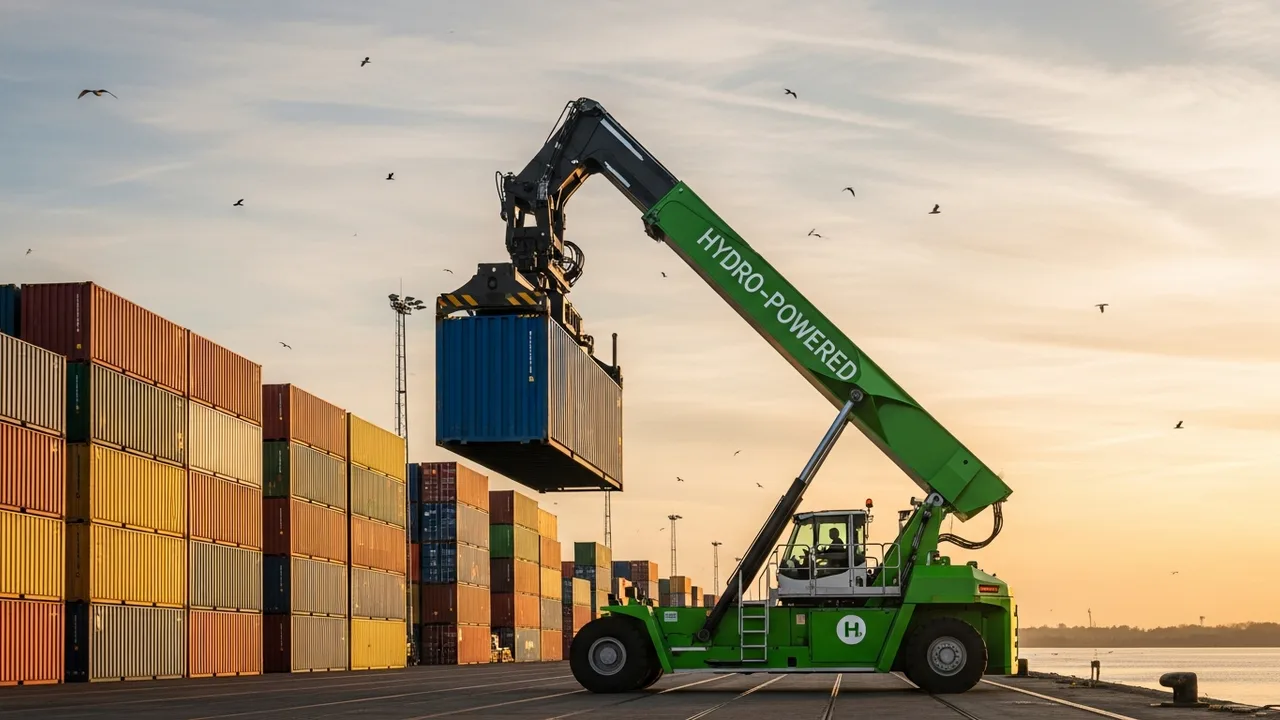
Decarbonising heavy port equipment is one of the hardest jobs in our sector, so it is worth recognising real progress when it happens. Hyster and Briggs Equipment have agreed to deploy a hydrogen fuel cell reachstacker at the Port of Tilbury, and it is a genuinely encouraging step for zero emission container handling in the UK.

Rachel's take
Decarbonisation is rewriting the sales conversation in this industry. The reps who can talk credibly about hydrogen, total cost and emissions targets are the ones operators will want in the room.
Rachel Lunn, Founder, EvaraA serious machine for a hard to electrify job
The Port of Tilbury, the largest of the eight ports operated by Forth Ports, has signed an agreement with Hyster and Briggs Equipment (UK) to put a hydrogen fuel cell powered reachstacker to work on the Thames. Reachstackers are among the most demanding machines on any terminal, lifting laden containers shift after shift, and that workload has made them one of the hardest categories to move away from diesel.
The Hyster reachstacker uses a Nuvera fuel cell to convert hydrogen into electricity on board, charging the batteries that drive the machine. Hydrogen is stored in high pressure tanks that can be refilled in around ten to fifteen minutes, so the truck keeps pace with terminal shift patterns rather than waiting hours to recharge. That combination of zero emission running and quick refuelling is exactly what heavy port operations need.
A trial designed to prove it in real conditions
Unveiled at TOC Europe 2026, the reachstacker is expected to arrive within months and will run as a pre production trial of up to two years. That matters. A short demonstration proves a concept, but a trial measured in years, on a working quay, is how you find out whether the technology holds up against real duty cycles, weather and uptime expectations.
It also reflects a maturing programme rather than a single experiment. Hyster has already put hydrogen fuel cell reachstackers into port service elsewhere in Europe, and bringing the technology to a major UK port through a local partner is a logical and confident next step.
Why the Briggs partnership matters
A machine like this is only as good as the support behind it. Briggs Equipment is one of the largest materials handling and asset management businesses in the UK and Ireland, with a nationwide depot network and a large engineering workforce, and it already supports operations at Tilbury. Pairing Hyster's equipment with that kind of service and uptime capability is what turns a clever prototype into something a terminal can actually rely on.
Credit to the teams at Hyster, Briggs Equipment and the Port of Tilbury for backing this. Congratulations on getting it to the quayside, and we will be following the trial with genuine interest.
What this means for commercial teams
- Hydrogen and electrification are changing how port and heavy equipment is sold, shifting the conversation from list price towards total cost of ownership, refuelling infrastructure and uptime, which rewards commercial people who can sell that whole picture.
- Trials like this create demand for sales and account managers who understand both the equipment and the customer's operation, and who can guide a terminal through a multi year move to zero emission handling.
This summary is based on the original announcements: Hyster H2 fuel cell reachstacker heading to the Port of Tilbury (WorldCargo News) · Hyster's hydrogen fuel cell reachstacker technology.