Sales & Commercial Leadership Edition
UK Intralogistics Talent Report 2026: Sales & Commercial Leadership Edition
This is the first edition of our annual read on the commercial side of UK intralogistics.
It looks past the headlines about drivers and warehouse operatives to the people who win and keep customers: the salespeople, account managers and commercial leaders who sell automation, equipment, storage and software.
It is, on balance, an optimistic read. The sector is growing again, and the people who sell into it have rarely been more valuable.
Every figure here is attributed to a named, public source. Where we could not verify a number, we have left it out.
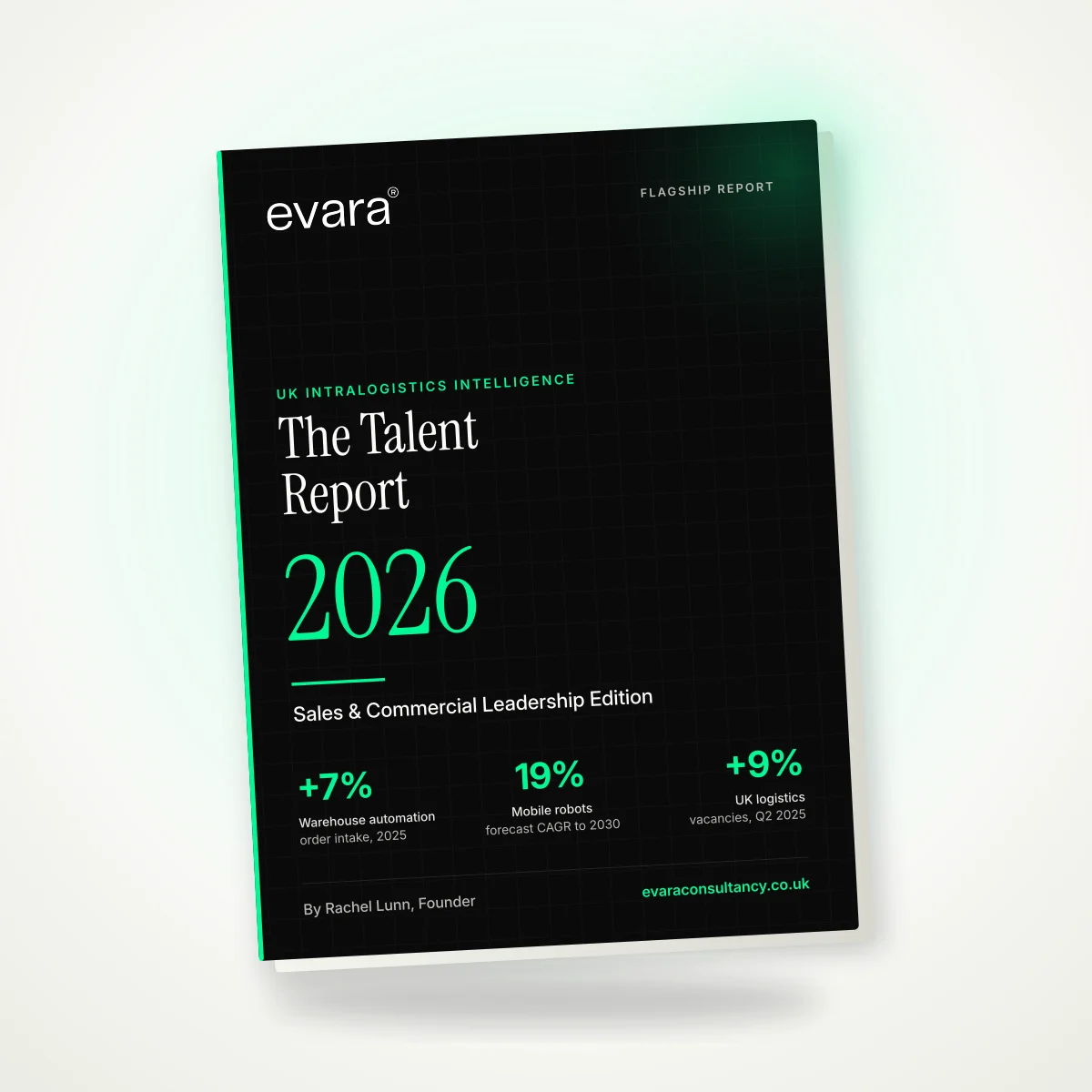
+7%
UK and global warehouse automation order intake growth in 2025
Interact Analysis
19%
Forecast annual growth for mobile robots to 2030
Interact Analysis
+9%
Rise in UK logistics vacancies in Q2 2025
CV-Library
Five things commercial leaders should take from 2026
The intralogistics market is growing again, but the constraint on growth has quietly moved from machines to people, and specifically to the commercial people who can sell complex solutions to harder, larger buying groups.
Each of these themes is developed in the sections that follow, with the underlying figures attributed to their original publishers. The interpretation is ours; the numbers are not.
- 01
The market has turned the corner
After a soft 2024, warehouse automation order intake rose by 7% in 2025, mobile robots are forecast to grow at 19% a year to 2030, and the warehouse management software market is on track to roughly quadruple by 2033. Growth means hiring.
- 02
The UK is a growth pocket, not a laggard
Interact Analysis puts EMEA ahead of the Americas and APAC for warehouse automation growth to 2030, and names the UK among the European markets that are expanding. The demand for commercial talent is real and local.
- 03
The labour story everyone quotes is the wrong one
Public vacancy data is dominated by drivers and warehouse operatives. The harder, quieter shortage is commercial: people who can sell automation, software and long-cycle capital equipment. That gap rarely shows up in the headline numbers.
- 04
Buying has changed, so selling has to change
Buying groups now run from five to sixteen people, most show unhealthy internal conflict, and most buyers say they would prefer to buy without a rep until the decision gets hard. The job has shifted from presenting to orchestrating consensus.
- 05
Capital is flowing to software and robots, not just steel
The fastest growth is in autonomous mobile robots, order-fulfilment robotics and warehouse software. The commercial skill set has to follow the money, from box-moving toward consultative solution selling.
Read together, these themes point to a conclusion we find genuinely encouraging. This is one of the strongest moments we have seen in some time to build a commercial career, or a commercial team, in UK intralogistics.
The state of UK intralogistics
Two years of caution gave way to renewed growth in 2025. The recovery is uneven, but the direction is clear, and it is being led from Europe.
+7%
Warehouse automation order intake growth, 2025
Source: Interact Analysis, 2026: Warehouse automation order intake up by 7%
£11bn
Forecast global mobile-robot revenue by 2030, up from just under £4bn in 2024
£12.6bn
Forecast global warehouse management software market by 2033, from £3.1bn in 2026
Source: Grand View Research, 2026: Warehouse Management System Market Size, Share & Trends Analysis Report
+9%
UK logistics vacancies in Q2 2025, to 150,578 from 137,542 in Q1
Interact Analysis reports that warehouse automation order intake grew 7% year on year in 2025, after a 3% decline in 2024. Some of that rise reflects higher steel and labour costs inflating project values, but large-scale investment from retail giants such as Amazon, Walmart and Tesco also helped lift demand. Of the three major regions, EMEA has the strongest forecast for warehouse automation, at around 7% annual growth between 2025 and 2030, ahead of the Americas at 6% and APAC at 5%. Within Europe, Interact Analysis names the Netherlands, Northern Europe and the UK as growth markets.
Robotics is the engine. Interact Analysis forecasts mobile robots will grow at an average of 19% a year from 2024 to 2030, taking revenue from just under four billion pounds to eleven billion, and significantly outpacing the 2.4% annual growth it expects for fixed automation. The market is shifting from automated guided vehicles to autonomous mobile robots, with order-fulfilment robots forecast to account for around half of all mobile-robot shipments by 2030.
Software is the other growth story. Grand View Research values the global warehouse management software market at 2.7 billion pounds in 2025, rising to 3.1 billion in 2026 and 12.6 billion by 2033, a compound annual growth rate of 21.9% from 2026, with Europe holding the largest regional share. The wider supply-chain technology picture is consistent: the 2025 MHI Annual Industry Report describes robotics, automation and artificial intelligence combining to turn supply chains into complete, connected systems.
The labour data tells a narrower story than people assume. CV-Library found UK logistics vacancies rose 9% in the second quarter of 2025, but nine of the ten most in-demand roles were driving roles, and warehouse operative was the single most advertised job. That is the operational labour market. It is not the commercial one, and conflating the two is how companies end up under-investing in the salespeople who actually drive revenue.
Percent per year, 2024 to 2030. Source: Interact Analysis, 2026.
The headline is a hopeful one. The market is growing, that growth is being led from Europe, and the UK is firmly part of it. For anyone who sells in this sector, that is a tailwind.
Sources
- Interact Analysis, 2026: Warehouse automation order intake up by 7%
- Interact Analysis, 2026: Mobile robots market outpaces fixed automation with 19% annual growth to 2030
- Grand View Research, 2026: Warehouse Management System Market Size, Share & Trends Analysis Report
- CV-Library, 2025: Logistics jobs surge: UK sector grows 9% in Q2 2025 even as nationwide hiring slows
- MHI and Deloitte (reported by Modern Materials Handling), 2025: 2025 MHI Annual Industry Report: The Digital Supply Chain Ecosystem
Where investment is flowing
If you want to know which commercial teams will be hiring, follow the capital. These are the categories drawing the most investment, ranked by the strength of the public forecasts behind them.
- 01
Autonomous mobile robots
The fastest-growing category in the warehouse. Interact Analysis forecasts 19% annual growth for mobile robots to 2030 and a clear shift from automated guided vehicles to autonomous mobile robots, whose share of the market keeps rising.
- 02
Order-fulfilment robotics
Driven by warehouse and e-commerce demand, order-fulfilment robots are forecast to make up around half of all mobile-robot shipments by 2030, the largest single application.
- 03
Warehouse management and execution software
Grand View Research forecasts the warehouse management software market will grow at 21.9% a year to reach 12.6 billion pounds by 2033, with Europe the largest region and cloud deployment leading.
Source: Grand View Research, 2026: Warehouse Management System Market Size, Share & Trends Analysis Report
- 04
Grocery and general-merchandise distribution centres
Large retailers are still building. Interact Analysis credits major facility investment from the likes of Amazon, Walmart and Tesco with helping lift automation order intake in 2025.
Source: Interact Analysis, 2026: Warehouse automation order intake up by 7%
- 05
Last-mile and parcel automation
Interact Analysis forecasts renewed growth in the parcel sector at around 6% a year between 2025 and 2030, fuelled by investment in last-mile automation.
Source: Interact Analysis, 2026: Warehouse automation order intake up by 7%
The pattern is encouraging for commercial teams. Capital is flowing into exactly the categories where a skilled seller adds the most value, the complex, consultative sales that machines will never close on their own.
Ranking reflects the relative strength and specificity of the public growth forecasts cited, not Evara's commercial preference. All figures are attributed above.
The commercial roles most in demand
A point-in-time read on the sales and commercial roles we see moving fastest across UK intralogistics. This is a qualitative demand picture, not a salary survey, and it deliberately carries no pay figures.
The pattern across these roles is consistent. The hardest hires are no longer the people who can demonstrate a machine. They are the people who can sit with a customer, understand a problem, and assemble a solution from equipment, software and service. That is a different skill, and the supply has not kept pace with the shift in what the market is buying.
| Commercial role | Demand | Why it is hard to hire |
|---|---|---|
| Solutions and pre-sales consultant | High | Sits between sales and engineering. Needs to translate automation and software into commercial value, and the talent pool is small. |
| Business development manager, automation and systems | High | Long sales cycles and technical buyers mean genuine new-business hunters with sector credibility are scarce. |
| Software and SaaS sales, WMS and WES | High | Software-led selling is newer to the sector, so people who can run a modern subscription sales motion are in short supply. |
| Key account manager, national accounts | Elevated | Retaining and growing complex accounts demands consultative skill and patience, not transactional selling. |
| Area and regional sales manager, capital equipment | Elevated | The core commercial engine for forklift and handling businesses. Strong field sellers who can also lead are always contested. |
| Aftermarket and service sales manager | Elevated | Service and parts revenue is where margin lives, and the commercial talent to grow it is often overlooked. |
| Commercial and sales director | Steady | Leadership roles turn over less often, but the bar for hires who can build a modern commercial function keeps rising. |
Demand levels are directional, not measured. They reflect Evara's live briefs and a point-in-time scan of public job boards in mid-2026. They will move with the market.
We do not see this shortage as a problem to dread. A genuine talent gap is also a genuine opportunity, for candidates who want to progress quickly and for employers willing to back the right people early.
This section is Evara's own qualitative assessment. It is not drawn from a third-party dataset, and we have not attached pay figures because we cannot publish a salary benchmark we have not robustly measured.
The levels of a sales career in intralogistics
Intralogistics offers a genuinely rewarding commercial career ladder. You can start on the phones and end up in the boardroom, and many of the sector's best commercial leaders have done exactly that.
We are often asked what a sales career in this sector actually looks like, so here is our own view of the three broad levels, what each one owns, and what we look for when we hire into it. The titles vary from business to business, but the shape of the journey is remarkably consistent.
What makes intralogistics special is how quickly capable people can move. Because the products are technical and customers stay for years, sector knowledge compounds. A representative who learns throughput, return on investment and integration risk early can grow into a formidable field seller with experience, and the field sellers who learn to build and coach a team become the commercial leaders the whole industry competes for.
| Level | Typical titles | What they own | What we look for |
|---|---|---|---|
| Entry level | Sales development representative, internal sales, hire desk and rental sales, trainee account manager | Pipeline, qualification and the first conversations. This is the engine room, where product knowledge and customer instinct are built. | Curiosity, energy and coachability. The sector rewards people who learn the equipment and the customer quickly, and there is real room to grow. |
| Field sales managers | Area sales manager, business development manager, key account manager, solutions and pre-sales consultant | Territories, named accounts and live deals. They carry the number and sit between the customer, engineering and the wider business. | Sector credibility, consultative skill and resilience across long sales cycles. The best can sell equipment, software and service as one solution. |
| Sales leadership | Sales manager, regional sales director, head of sales, commercial director, sales and marketing director | Strategy, the team and the forecast. They build the commercial function, coach the next generation and answer to the board. | People who have done the job, can build a modern commercial engine and lift everyone around them. These are the hires that change a company's trajectory. |
Titles and structures vary by business. Many strong commercial people also build deep specialist careers, for example in pre-sales, bid management or aftermarket sales, without ever moving into people leadership.
This is an industry where ambition is rewarded. If you are good with customers and willing to learn the technical side, intralogistics will give you somewhere to go.
This career ladder is Evara's own view of how commercial roles tend to progress across material handling, automation, storage and software. It is offered as a guide for candidates and hiring managers, not as a rigid structure.
The rise of consultative selling
The reason consultative skill is so valuable is that buying itself has become harder. The independent research on B2B buying is unambiguous, and it has direct consequences for how intralogistics teams sell.
5 to 16
People now involved in a typical B2B buying group, across up to four functions
74%
Of B2B buyer teams show unhealthy internal conflict during the decision
2.5x
Buying groups that reach consensus are more likely to report a high-quality deal
75%
Of B2B buyers say they would prefer a rep-free buying experience, yet self-service buyers report more regret
Source: Gartner: B2B Buying: How Top CSOs and CMOs Optimise the Journey
Gartner's 2025 sales survey of 632 B2B buyers found that buying groups now range from five to sixteen people across as many as four functions, and that 74% of buyer teams demonstrate unhealthy conflict during the decision process. Crucially, the groups that reach consensus are two and a half times more likely to say they got a high-quality deal. The seller's job is no longer to win one champion. It is to help a divided group agree.
Gartner's wider B2B buying research adds a twist. Around three quarters of buyers say they would prefer to buy without a sales rep, but the buyers who go fully self-service are more likely to regret the purchase. The winning approach is hybrid: let buyers self-serve where they want to, and bring real human expertise to bear at the points where the decision is hard and the risk is high.
McKinsey's ninth B2B Pulse Survey, drawing on responses from nearly four thousand decision makers across thirty-four sectors and thirteen countries, reaches a compatible conclusion. Customers now behave like consumers, expect a sophisticated omnichannel experience, and will walk away if they do not get it. Market leaders treat omnichannel and human expertise as the path to growth, not a cost to be cut.
For intralogistics, where a single automation or systems decision can involve operations, finance, IT and the board, this is not abstract. It is the daily reality of the deals your commercial team is trying to close. The salespeople who thrive are the ones who can navigate a complex group, not just deliver a strong pitch.
The job has shifted from presenting a product to orchestrating a decision. That is the single most important commercial capability to hire for in 2026.
Traits of great commercial leaders
Based on our own observations across material handling, automation and intralogistics, the commercial leaders who consistently outperform tend to share a recognisable set of traits. This section is editorial, not statistical.
- They sell the problem, not the product. They start from the customer's operation and work back to the solution, rather than leading with a catalogue.
- They are fluent in two languages: the engineer's and the chief financial officer's. They can translate a technical solution into a commercial and financial case.
- They build for retention, not just the win. They treat aftermarket, service and account growth as where the real margin lives.
- They orchestrate buying groups. They are comfortable managing a decision across operations, finance, IT and the board, and they help that group reach agreement.
- They hire and coach ahead of demand. They build the bench before the growth arrives, rather than scrambling once it does.
- They are credible in the field and in the boardroom. They have done the job, and they can also defend a forecast and a plan to a leadership team.
These observations reflect Evara's experience in the sector. They are offered as a hiring lens, not as findings from a survey.
Commercial moves across the industry
A selection of recent, publicly reported commercial developments across UK and European intralogistics, each one a small signal of where the market is heading. Every item links to the original reporting.
SHS Handling Solutions acquires WSS
SHS Handling SolutionsConsolidation in forklift service and engineering as players buy nationwide coverage.
Clark Europe opens a Ruhr region branch
Clark EuropeAn OEM adding direct commercial coverage alongside its dealer network in a key region.
Powerlift opens a new Skelmersdale depot
PowerliftNetwork expansion in the North West, putting sales and service closer to customers.
Palletways Birmingham promotes two as it backs growth
PalletwaysInternal commercial promotions used to underpin further expansion.
HCUK positions itself as a growth partner for dealers
HCUKA channel-first commercial strategy, helping dealers grow rather than competing with them.
Hyundai steps up its European electric forklift push
Hyundai Material HandlingAn OEM doubling down on its electric range to win share in a shifting market.
These are publicly reported developments summarised by Evara, with original reporting linked on each item. Inclusion is illustrative and implies no commercial relationship with Evara.
Twenty-five businesses to watch
An editorial selection of companies shaping the commercial side of intralogistics, grouped by category and listed alphabetically within each group. This is not a ranking, an endorsement, or a statement of any commercial relationship.
Automation and systems integration
Dematic
Global materials handling systems integrator within the KION Group, known for large automated fulfilment systems.
Element Logic
Norwegian systems integrator and long-standing AutoStore partner, active across UK warehouse automation.
Knapp
Austrian intralogistics specialist focused on automated picking and software for retail, healthcare and fashion.
Swisslog
Automation and robotics integrator within KUKA, strong in healthcare and warehouse storage and retrieval systems.
TGW Logistics
Austrian, foundation-owned integrator specialising in automated fulfilment for retail and grocery.
Robotics and autonomous mobile robots
AutoStore
Norwegian cube-storage robotics pioneer and one of the most widely deployed goods-to-person systems.
Exotec
French robotics business behind the Skypod goods-to-person system.
Geek+
Robotics maker with a broad goods-to-person and sortation range.
Locus Robotics
Autonomous mobile robot specialist for collaborative warehouse picking.
Ocado Technology
UK grocery technology business licensing its automated fulfilment platform internationally.
Storage and racking
BITO Storage Systems
German storage and small-parts bin specialist active in the UK.
Mecalux
Spanish storage systems and automated storage manufacturer with a global footprint.
SSI Schäfer
German storage and intralogistics group spanning racking, shuttles and software.
Stow Group
European racking and automation manufacturer within the Averys group.
Whittan
UK storage equipment group behind brands including Link 51 and Apex.
Forklift and materials handling equipment
Briggs Equipment
UK materials handling and asset management provider and distributor for Hyster and Yale.
Combilift
Irish manufacturer of multidirectional and long-load handling trucks, an export-led success story.
Jungheinrich
German forklift and warehouse technology manufacturer with growing automation and energy lines.
Linde Material Handling
Premium forklift and warehouse truck brand within the KION Group.
Toyota Material Handling UK
Market-leading forklift and warehouse equipment supplier with a large UK service network.
Supply chain and warehouse software
Blue Yonder
Supply chain planning and execution software group within Panasonic.
Generix Group
European supply chain and warehouse management software vendor.
Körber Supply Chain Software
Software and automation arm of Körber, including warehouse management and voice solutions.
Manhattan Associates
Supply chain and warehouse management software leader.
SnapFulfil
UK cloud-native warehouse management system from Synergy Logistics.
The businesses above were chosen by Evara for their relevance to the commercial side of the sector. The list is illustrative and implies no ranking or commercial relationship.
Why we are optimistic about intralogistics
We will end where we began, on a hopeful note. After two cautious years, this is a sector with the wind at its back, and the commercial people who serve it have rarely mattered more.
The machines are getting cleverer, the software is getting better and the buildings are getting busier, but none of it sells itself. Every robot, rack and warehouse system still reaches the customer through a person who understood the problem and earned the trust to solve it. That is the work we care about, and it is work with a real future.
For candidates, that means a career with room to climb and skills that travel well. For employers, it means the teams that invest in commercial talent now will be the ones taking share when the next wave of automation lands. And for the industry as a whole, it is a chance to tell a more confident story about itself, as one of the most important and most exciting corners of the British economy.
That is the spirit we want this report to be read in. The numbers are sober and fully sourced, but the conclusion is upbeat. There has rarely been a better time to sell, to lead, or to hire in UK intralogistics.
Growth is back, the work matters, and the people who can sell it are the people who will shape what comes next. We are very optimistic about where this industry is heading.
This outlook is Evara's own opinion. It carries no figures beyond those already sourced earlier in this report.
Sources and methodology
Data integrity
Every figure in this report is attributed to a named, public source. Where a number could not be verified, it was left out rather than estimated. The roles, career levels, leadership and outlook sections are Evara's own qualitative view and carry no invented figures.
This report combines independent market data with Evara's own qualitative view of the commercial talent market in UK intralogistics. The two are kept separate and clearly labelled.
Every figure presented as data is attributed to a named third-party publisher, with the year where known and a public link. Where we could not verify a figure against a public source, we left it out rather than estimate it. Market sizes quoted from research firms reflect those firms' own definitions and scopes, which differ. Where a research firm publishes a market size in US dollars, we have converted it to pounds at approximately one pound to 1.27 dollars and rounded for readability; the figure in the original source remains in dollars.
The roles in demand, career levels, leadership traits and outlook sections are Evara's own qualitative assessment, drawn from live search briefs and a point-in-time scan of public job boards in mid-2026. They are directional and carry no pay figures, because we will not publish a salary benchmark we have not robustly measured.
The commercial moves section summarises publicly reported developments, with the original reporting linked on each item. The businesses to watch section is an editorial selection and implies no ranking or commercial relationship.
This is the first edition. Two further sections, a detailed analysis of candidate shortages and a survey of intralogistics chief executives on hiring, are planned for a later edition once the underlying data has been gathered to the same standard.
References
- 01Interact Analysis, 2026: Warehouse automation order intake up by 7%
- 02Interact Analysis, 2026: Mobile robots market outpaces fixed automation with 19% annual growth to 2030
- 03Grand View Research, 2026: Warehouse Management System Market Size, Share & Trends Analysis Report
- 04CV-Library, 2025: Logistics jobs surge: UK sector grows 9% in Q2 2025 even as nationwide hiring slows
- 05MHI and Deloitte (reported by Modern Materials Handling), 2025: 2025 MHI Annual Industry Report: The Digital Supply Chain Ecosystem
- 06Modern Materials Handling, 2026: Robotics moves into the warehouse mainstream (2026 intralogistics robotics survey)
- 07Gartner, 2025: Gartner Sales Survey Finds 74% of B2B Buyer Teams Demonstrate Unhealthy Conflict During the Decision Process
- 08Gartner: B2B Buying: How Top CSOs and CMOs Optimise the Journey
- 09McKinsey & Company, 2024: Five fundamental truths: How B2B winners keep growing (B2B Pulse Survey)
Hiring commercial talent in intralogistics? Email Rachel Lunn
Talk to Evara.
Specialist commercial search for the intralogistics industry. We reply within one working day.
Email Rachel Lunn