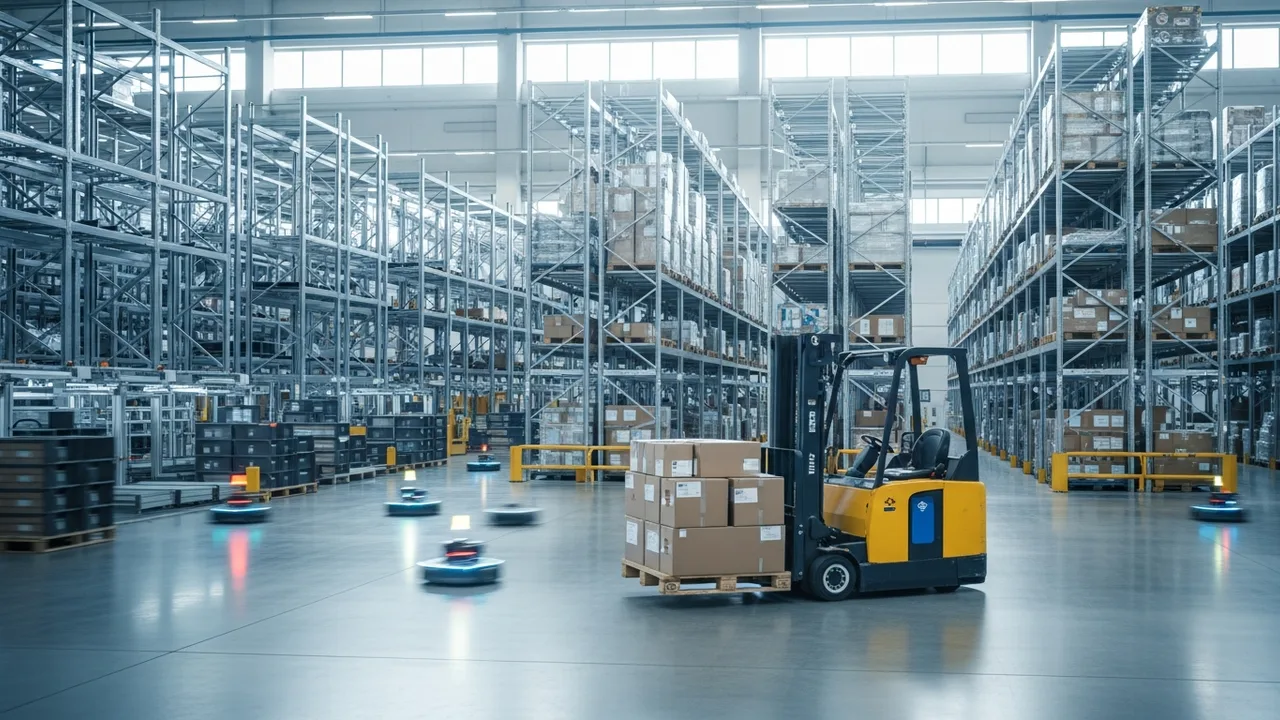
Europe is one of the engine rooms of the global intralogistics industry, and the data backs it up. The market that covers material handling, warehouse automation, storage and supply chain technology is large, resilient and growing at close to double digits a year. For anyone who sells into it, the direction of travel is clear and positive.

Rachel's take
The numbers tell the story we see every day. European intralogistics is scaling, the manufacturers and operators behind it are investing, and the commercial people who can sell into that growth are in real demand.
Rachel Lunn, Founder, EvaraA market measured in tens of billions
Grand View Research puts the European intralogistics market at around 15.2 billion dollars in 2024, with growth of close to 10 per cent a year taking it to roughly 33.8 billion dollars by 2033. That sits inside a global intralogistics market on track to pass 145 billion dollars by 2030, so Europe is no side market. It is one of the largest and fastest moving regions in the world.
The momentum is strongest in automation. Demand for automated storage and retrieval, autonomous mobile robots and the software that orchestrates them is rising at double digit rates across the continent, as operators invest to handle more volume with tighter margins.
Germany leads, the gateways move the volume
Germany is the anchor. It held close to 38 per cent of Europe's intralogistics automation market in 2024, according to Grand View Research, and it is home to KION Group in Frankfurt and Jungheinrich in Hamburg, the two largest lift truck manufacturers in Europe. The wider DACH region carries much of the design and build of the equipment the rest of the continent runs on.
The volume then flows through the Benelux. Rotterdam and Antwerp Bruges are the two largest container ports in Europe, feeding the distribution estates and third party logistics operators of the Netherlands and Belgium. The Nordics lead on robotics and fulfilment automation, while France, Italy and Iberia add deep manufacturing and a fast growing automation appetite. Poland and Central Europe have become the continent's fastest growing distribution base, drawing a rising share of new warehouse and automation investment as occupiers push east for space and cost.
Growth this steady needs people to sell it
A market that nearly doubles over a decade does not run on technology alone. Every new automation line, fleet contract and storage system is sold, specified and supported by commercial and sales people who understand both the kit and the customer. As investment rises across the UK and mainland Europe, demand for that talent rises with it.
That is the part of the market we watch most closely. The growth is real, it is broad based across the major European economies, and it is creating some of the most interesting commercial roles in the industry.
Founder, Evara
What this means for commercial teams
- European intralogistics is a large, resilient market growing at close to 10 per cent a year, so commercial hiring plans should be built around expansion rather than caution.
- Demand is concentrated in identifiable hubs, from the German manufacturing base and the fast growing Polish and Central European distribution corridors to the Benelux gateways and the Nordic robotics cluster, which makes targeted market mapping far more effective than scattergun search.
- Automation investment is outpacing the supply of people who can sell it, so the businesses that move early on commercial talent tend to win the best operators.
This summary is based on the original announcements: Grand View Research, Europe intralogistics market outlook · Next Move Strategy Consulting, global intralogistics market.